
As India hosts the BRICS Summit in 2026, we, the people of one of BRICS’s founding countries, call on BRICS members to forge a development model based on solidarity, dignity, participatory democracy, and respect for human rights and the environment. The emergence of BRICS in 2009 signalled hope and much needed possibilities for South-South cooperation, and South led global governance that would reform international financial and economic institutions, processes and architecture to break the dominance of former colonial powers and the hegemony of the US dollar over the world’s economy. Such South led global governance would ensure greater voice for developing countries in regional, international and multilateral fora that have been shaped by colonial histories and continuing inequalities, racism, religiocentrism, casteism and patriarchy.
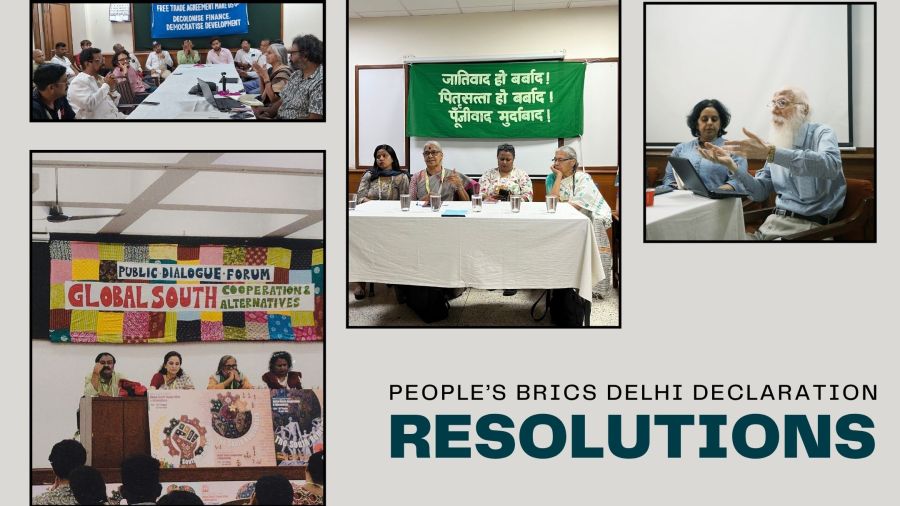
In a Public Dialogue Forum in New Delhi on 21-22 August 2026 in the run-up to the BRICS Summit in September 2026, civil society organisations, trade unions, students, researchers, people’s movements and other constituencies gathered to envision and voice what South-South cooperation and an alternative global order means for working peoples, rural and urban communities, and peoples’ movements and organisations, rather than for capital, corporations, elites and geopolitical blocs.
We note that while BRICS continues to be viewed as a potential challenge to western economic and financial dominance, its potential and promise to break away from colonial mindsets and logic, and build an alternative world order remain unfulfilled.BRICS member countries continue to reproduce extractivist and inequitable development, and advance neoliberal trade and investment, corporate concentration, privatisation and financialisation, which have resulted in widespread destruction of eco-systems and livelihoods, violation of peoples’ rights, and forced displacement of entire populations. Justice systems in BRICS countries remain weighted in favour of ruling regimes and their supporters, and laws and regulations are increasingly weaponised to suppress dialogue, dissent and democratic processes. National security, and social-economic stability continue to be used as justifications for the persecution of people and communities with heterodox views, and who dare to demand and defend their rights and dignity.
We emphasize that “South-South cooperation” be recognised not by the sovereignty it grants to states and capital, but by the freedom, security and dignity it delivers to working peoples, farmers, workers, women, Dalits, Adivasis, minorities and communities across the Global South. As a political formation, BRICS has remained shockingly silent on genocide, ethnic cleansing and western military aggression.
In the face of accelerating climate change, persisting hunger, increasing inequality and social-economic precarity, continuing wars and genocide, resurgence of fascist tendencies, subversion of democracy and breakdown of multilateralism, a progressive, just, pro-people and pro-environment vision and approach of South-South cooperation is timely and urgent. Drawn from discussions over two days, we present the following resolutions to BRICS member countries and BRICS as a whole, to adopt and implement.

